AI Promises Everything - But is it really ready and are you?
But Is Your Revenue Engine Actually Ready?
AI is everywhere in revenue tech right now.
AI-powered forecasting. AI-driven insights. AI is telling you what to do next.
It sounds incredible. And if you’re a founder or revenue leader under pressure to scale, it’s tempting to believe AI is the shortcut to clarity, the lever that finally makes everything click.
But here’s the uncomfortable truth:
AI is only as good as the system and data behind it.
And for many companies, that foundation simply isn’t ready.
The “Just Plug It In” Illusion
Most AI tools assume a near-perfect environment. They expect a clean CRM, clearly defined processes, aligned teams, and consistent definitions of pipeline, revenue, and performance. In that world, AI works beautifully.
In reality, most companies don’t operate in that world.
Data lives across multiple tools. Sales, marketing, and customer success track metrics differently. Forecasts rely on manual updates and spreadsheets. Definitions change from meeting to meeting. The CRM contains missing fields, duplicate records, and outdated information.
When you add AI on top of that environment, you don’t get clarity.
You get automated confusion.
AI doesn’t create truth; it amplifies patterns. If your data reflects inconsistency, broken processes, or incomplete records, AI will confidently generate inaccurate forecasts, misleading recommendations, and “insights” that feel intelligent but aren’t actionable. That’s how companies end up trusting dashboards they shouldn’t and making decisions based on flawed inputs.
The problem isn’t that AI doesn’t work.
The problem is that the revenue engine underneath it isn’t aligned.
The Missing Layer: Revenue Operations
What’s usually missing isn’t better software. It’s Revenue Operations.
RevOps is what aligns sales, marketing, and customer success around a shared system of execution. It defines how revenue actually flows through the organisation. It clarifies ownership of data. It establishes consistent processes. It ensures systems reflect reality instead of theory.
Without that foundation, every new tool (especially AI) magnifies the chaos.
With it, AI becomes powerful.
But instead of fixing the foundation, some companies take a different path.
They decide to build their own CRM.
The Dangerous Appeal of “Let’s Just Build It Ourselves”
With AI accelerating code generation, building custom software feels more accessible than ever. The logic seems simple: if our CRM doesn’t fit perfectly, why not just build one that does?
On paper, it sounds empowering.
In practice, it’s one of the most expensive strategic mistakes a mid-market or enterprise company can make.
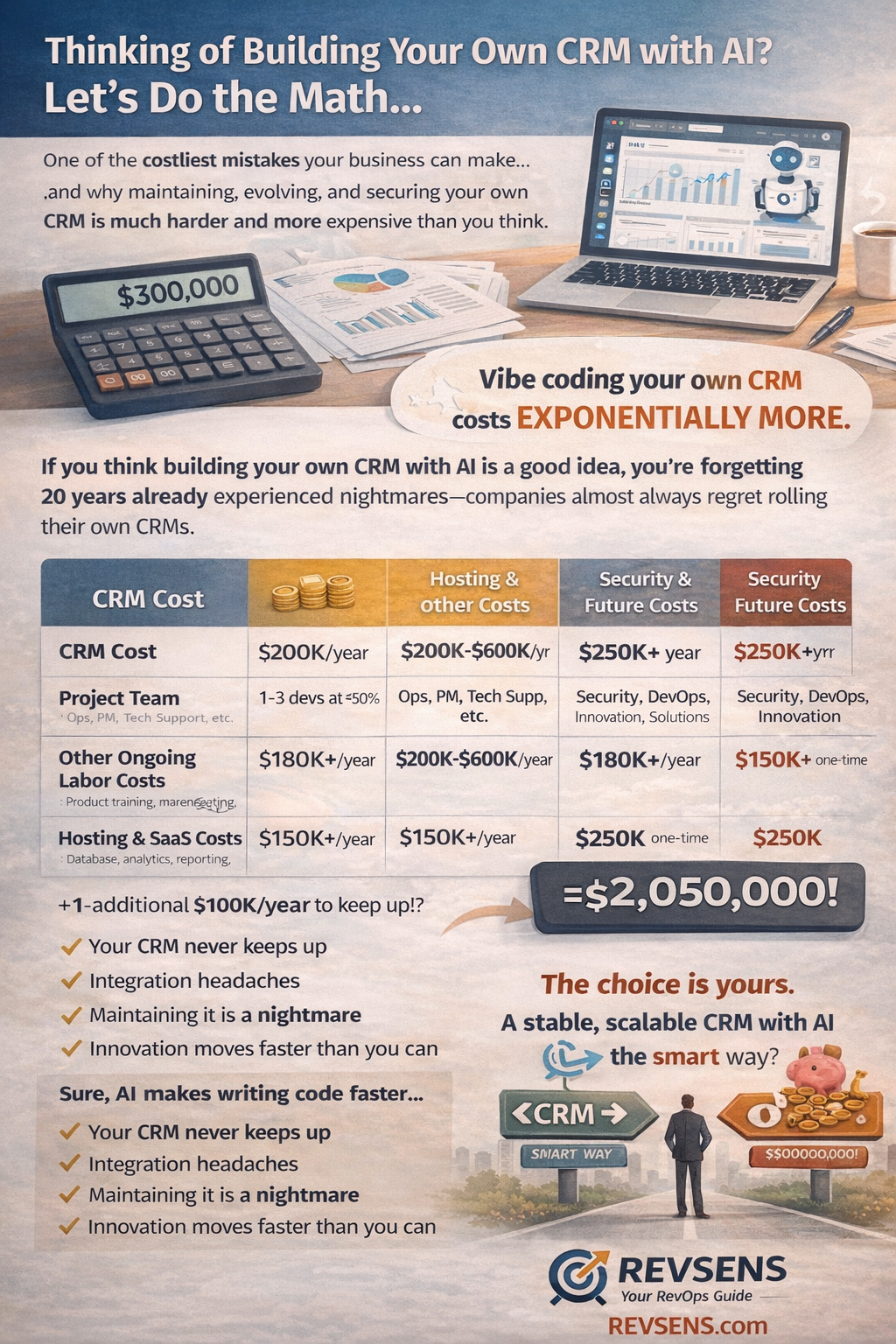
You might currently pay less than $300,000 per year for your CRM platform. That feels expensive — until you try replacing it.
Building your own CRM requires developers — often more than half-time, sometimes multiple full-time engineers. Add a product manager. Add marketing operations. Add technical support. Add a support engineer. That alone can run hundreds of thousands of dollars annually.
Then you layer in security. A security developer. A security analyst. DevOps. Penetration testing. Infrastructure management. Integrations engineering. Product design. The list grows quickly.
Then there’s hosting. Data warehousing. Analytics. Database infrastructure. Documentation. Training. Product marketing so your team actually adopts the features you just built. SaaS tools for email, SMS, integrations, and notifications that you now have to manage yourself.
And that’s before the first security incident, compliance challenge, or scaling bottleneck.
Companies have been trying to roll their own CRMs for over twenty years. Most of them don’t regret building version one.
They regret maintaining version ten.
Because a CRM is never “done.” It evolves as your business evolves. Processes change. Data models expand. Edge cases multiply. Integrations break. Compliance requirements tighten. Customer expectations rise.
AI makes writing code faster.
It does not make data models future-proof.
It does not make integrations maintain themselves.
It does not eliminate edge cases.
It does not stop your go-to-market motion from changing.
Once your entire revenue engine depends on your custom-built CRM, you’re locked into owning it — forever.
AI changes how software is built.
It does not change which software you should never want to own.
The Right Order of Operations
There’s a better sequence.
AI is not the first step. It’s the multiplier.
If your processes are clear, your data is trustworthy, and your teams are aligned, AI can dramatically increase performance. If those elements are broken, AI simply accelerates failure.
The companies that get real value from AI don’t start with the tool. They start with revenue clarity. They define how revenue flows. They align teams. They clean their data at the source. They implement a CRM that reflects reality. They build a strong RevOps foundation.
Then they add AI.
And when they do, it works.
The Bottom Line
Don’t plug AI into chaos.
Don’t build infrastructure you don’t actually want to own.
And don’t confuse faster code generation with faster growth.
The companies that scale predictably follow a different order:
RevOps first.
CRM second.
AI last.
Because when the foundation is solid, AI isn’t noise. It’s leverage.